
Home Page » News & Articles » What are B, C, and D type miniature circuit breakers (MCBs) and what are their differences?
What are B, C, and D type miniature circuit breakers (MCBs) and what are their differences?
Before examining the applications of each type of miniature circuit breaker (MCB), it is better to first understand the concept of the trip curve. A trip curve indicates at what current and after how much time the MCB will disconnect the circuit.
What is the difference between B, C, and D trip curves?
The main difference between B, C, and D trip curves lies in their magnetic trip threshold. In simple terms, these curves specify how much sudden current increase the MCB can tolerate before instant disconnection.
These three curves are the most common types of trip curves in protective systems, each designed for a specific type of load—from simple resistive loads to motor circuits and inductive loads.
MCBs, as protective devices, are designed to protect electrical circuits against overcurrent and short-circuit conditions.
Their operation is based on two main protective mechanisms:
Thermal Trip
This mechanism reacts to continuous and sustained overcurrents, such as long-term motor operation. The response speed of the thermal trip is affected by ambient temperature and usually disconnects the circuit with a delay to prevent overheating of wires and equipment.
Magnetic Trip
The magnetic trip operates instantaneously without delay against short circuits and high inrush currents. This part plays a crucial role in preventing sudden and dangerous damage.

What information does a trip curve chart show?
A trip curve chart or table displays the relationship between the current passing through the circuit and the time it takes for the MCB to trip. These charts are usually drawn on a logarithmic scale to accurately represent the performance of the miniature circuit breaker under various overcurrent and short-circuit conditions.
Understanding the B, C, and D trip curves helps you choose the right MCB for each type of circuit and ensures the safety, stability, and longevity of electrical equipment.
What is a Type B circuit breaker and what is it used for?
Type B breakers are designed to trip quickly when the current reaches 3 to 5 times the rated current. This makes them the most sensitive type of MCB.
Type B MCBs are mostly used for residential and low-voltage commercial applications, where sudden current surges are small and limited. Their fast response helps prevent damage to sensitive electrical devices and increases personal safety.
In general, if your goal is to protect sensitive home appliances and ensure a safe electrical system in residential buildings, Type B is an ideal and reliable choice.
What is a Type C miniature circuit breaker and what is it used for?
Type C MCBs are designed for higher-power electrical devices, where sudden surges or inrush currents are more likely. Therefore, these breakers are widely used in commercial, workshop, and light industrial environments.
Type C breakers operate when the current reaches 5 to 10 times the rated current, making them suitable for circuits with inductive or motor loads. Common applications include small electric motors, pumps, light industrial equipment, and fluorescent lighting.
A key advantage of Type C breakers is their ability to handle short-term inrush currents, which usually occur during motor startup. This makes them less likely to trip accidentally compared to Type B, providing greater stability in the circuit.
Overall, for semi-industrial and commercial circuits, Type C is a smart and practical choice.
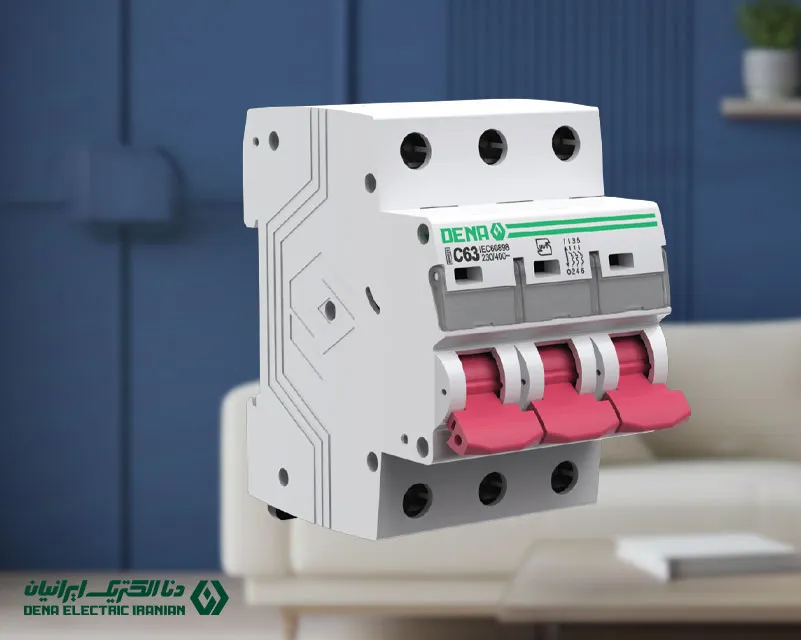
Dena Electric Iranian Company manufactures a variety of MCBs with B and C trip curves, using modern technologies and international standards to ensure the safety and protection of electrical circuits in residential, commercial, and industrial applications.
What is a Type D Miniature Circuit Breaker and what is it used for?
Type D MCBs are the least sensitive type of miniature circuit breakers. They only trip when the current reaches 10 to 20 times the rated current, making them suitable for conditions where very high inrush currents occur momentarily.
Type D MCBs are designed for heavy commercial and industrial equipment, where sudden and large current surges are common. Typical applications include welding machines, X-ray devices, large electric motors, and UPS systems.
The main advantage of Type D MCBs is their ability to withstand very high initial currents without unwanted tripping. They only operate when the overcurrent persists for a certain duration, effectively protecting heavy equipment.
In general, if you are dealing with heavy industrial loads and high inrush currents, a Type D MCB is the best choice. Due to its low sensitivity, it is rarely used in residential applications.
Other types of MCBs and their applications
Besides the common B, C, and D curves, there are specialized MCBs designed for specific applications. Choosing the right model is important for increasing safety, reducing unwanted trips, and protecting equipment accurately.
Type K MCB
Type K MCBs operate when the current reaches 8 to 12 times the rated current, allowing them to handle short-term inrush currents effectively. This makes them ideal for motor circuits, especially where the motor startup current is higher than normal but precise protection is still needed.
Type Z MCB
Type Z MCBs are highly sensitive, tripping when the current reaches 2 to 3 times the rated current. This makes them perfect for very delicate and sensitive equipment, such as semiconductors, precision electronic circuits, and systems vulnerable to short circuits.
If you deal with motors and moderate inrush currents, Type K is suitable. For sensitive electronics and precision devices, Type Z is the best choice.
How to select the right MCB
Choosing the correct MCB is critical for the safety, stability, and proper functioning of electrical systems. The type of MCB depends on the electrical equipment specifications, load type, and installation conditions. Key factors to consider include:
Trip Characteristics – Determines at what current and how fast the MCB will trip. Choose the curve (B, C, D, K, or Z) according to load type: resistive, motor, or sensitive electronic equipment.
Breaking Capacity – The maximum current the breaker can safely interrupt without mechanical damage or dangerous arcing. Usually expressed in kA (1 kA = 1000 A). Proper rating is critical, especially in industrial environments or near powerful power sources.
Number of Poles – Options include:
Single pole + neutral (1p+n)
Three poles + neutral (3p+n)
In three-phase systems, three-pole MCBs or three-pole + neutral are used to simultaneously cut off all phases in case of a fault, providing higher safety.
Selecting an MCB with the proper trip characteristics, breaking capacity, and number of poles ensures equipment protection and prevents unwanted trips or electrical hazards.
For additional safety and electrical protection, Dena Smart solutions offer advanced home automation systems for intelligent and secure smart homes.
Available links
Useful links